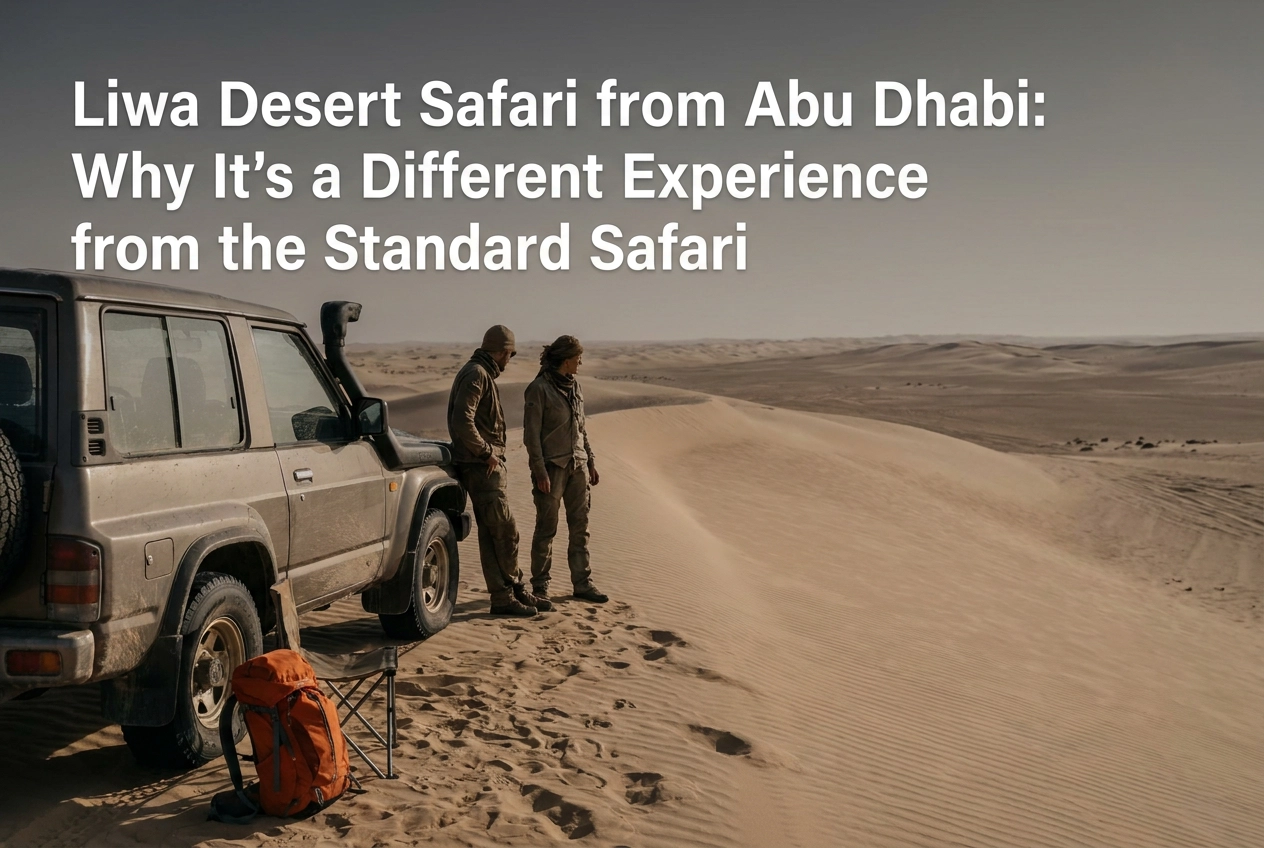
Most desert safaris in Abu Dhabi follow a familiar script: a short drive out of the city, some dune bashing, a buffet dinner under the stars, and back to your hotel by midnight. It’s a great evening out, but it’s not exactly pushing the boundaries of what the desert can offer.
A Liwa desert safari from Abu Dhabi is a genuinely different conversation. Sitting 250 kilometres south of the city on the edge of the world’s largest continuous sand sea, Liwa’s mega-dunes belong to a landscape so remote and untouched that it barely registers on the typical tourist radar. This is the birthplace of Abu Dhabi’s ruling dynasty, a region shaped by centuries of Bedouin life, and a place where silence is the dominant sound.
If you’re trying to decide whether Liwa is worth the extra planning, this guide breaks it all down. You’ll find a clear look at what the standard safari offers, what makes Liwa categorically different, the cultural weight it carries, and a practical side-by-side comparison to help you figure out which experience actually fits your group.
Not All Abu Dhabi Desert Safaris Are the Same Product
Search for a desert safari from Abu Dhabi and you will quickly land on a cluster of options all sitting within an hour of the city. Most visitors assume this is simply what an Abu Dhabi safari looks like, and for a first trip, that assumption is reasonable. These proximity-based experiences are polished, well-run, and genuinely enjoyable. They are also, by nature, convenience products: designed for easy access, operating in landscapes that sit close to Abu Dhabi’s expanding urban edge.
Liwa is a different proposition entirely. It sits 250km south of Abu Dhabi on the north-eastern fringe of the Rub’ al Khali, the largest continuous sand desert on earth. The terrain, the scale, and the sense of remoteness belong to a different category of experience. Calling both options “a desert safari” is a bit like calling a city cycling tour and a mountain trail ride the same activity because both involve bikes.
That distinction matters if you are trying to decide where to spend your time and budget. This is not a quality comparison; both products do what they promise. It is a profile comparison: what do you actually want the desert to give you? Whether you are already planning your Abu Dhabi weekend or simply exploring what the region offers beyond the headline attractions, understanding this gap is the right place to start. This piece maps the differences clearly so you can choose with confidence.
What the Standard Abu Dhabi Safari Offers
So what does the standard offering actually look like? Most Abu Dhabi desert safari packages operate in Al Khatim or similar dune corridors to the east of the city, roughly 50 to 60 minutes from the city centre. That proximity is a deliberate design choice, not a compromise.
The format is consistent and well-engineered: afternoon pickup, sunset dune bashing in a 4×4, camel rides, sandboarding, and a BBQ buffet dinner with live entertainment before the return drive. Start to finish, you are looking at five to six hours. It is an evening out, not an expedition.
The camp infrastructure makes this work. Fixed seating, food stations, washrooms, and a programme of entertainment mean arrivals from a coach or a family car can step straight into the experience without any logistics to manage themselves. For first-time visitors, families with young children, or corporate groups looking for a shared activity, that structure is exactly what is needed. You can explore a broader range of desert adventure Abu Dhabi options to see how these experiences sit alongside other activity types in the region.
The dunes themselves are genuine desert terrain and photograph well. They are mid-scale formations, suited to recreational dune bashing and accessible for most fitness levels. What they are not is remote, and they are not large by the standards of the deep desert.
That last point is not a criticism. A standard safari is a crafted product built to deliver a specific outcome reliably. Understanding it on those terms is what makes the comparison with Liwa meaningful, rather than just a contest between a short drive and a long one.
What Makes a Liwa Desert Safari Categorically Different
Liwa starts where the standard safari ends, and the gap between them is not a matter of degree.
The dune fields here sit on the north-eastern edge of the Rub’ al-Khali, the largest continuous sea of sand in the world, covering 650,000km² across the UAE, Saudi Arabia, Oman, and Yemen. That scale is not just a geography fact; it reshapes every part of the experience on the ground.
The dunes themselves are a different proposition. Moreeb Dune (Tal Mireb) is among the tallest dunes in the UAE, with near-vertical faces that draw adventure travellers and landscape photographers specifically because nothing in a proximity-based safari zone compares. The formations are not just bigger; they behave differently under a 4×4, offer dramatically longer sandboarding runs, and produce shadow and light at golden hour that simply cannot be replicated on mid-scale terrain.
The silence is its own feature. From within the Liwa dune fields, there is no visible skyline, no pylons, no distant traffic hum. The only sounds are wind and, occasionally, camel calls from Bedouin herders working the edges of the oasis. That level of remoteness is structurally impossible closer to Abu Dhabi’s urban corridor.
The drive out (roughly 2.5 to 3 hours from the city) earns its place in the experience too. The landscape shifts progressively: highway infrastructure gives way to date palm corridors, then to raw, open sand as the oasis approaches. By the time you arrive, you have already left the city far behind, in every sense.
The Cultural and Heritage Layer That Sets Liwa Apart
The physical scale is only part of what separates Liwa from a standard Abu Dhabi safari. The cultural weight is just as significant, and far less often discussed.
Liwa Oasis is the ancestral homeland of the Al Nahyan family, Abu Dhabi’s ruling dynasty. The Bani Yas tribe, from which the Nahyans descend, were settled here long before the modern UAE existed. When the family moved to Abu Dhabi in the late 18th century, Liwa remained the foundation, the place the emirate’s story starts. No proximity-based desert safari can claim that history.
The Bani Yas cultivated date palms using underground freshwater reserves, sustaining life in one of the harshest environments on earth. Liwa was actively farmed and inhabited for centuries before the UAE’s founding, never merely a landscape to pass through.
This is not a recreated heritage village or a themed Bedouin camp built for tourists. It is a working oasis where the relationship between people, water, and desert has stayed largely intact. That distinction matters if you are looking for something genuine rather than curated.
For travellers who want to understand where the Arabian Peninsula actually came from, Liwa delivers context that no standard Abu Dhabi safari can replicate. The desert here is not a backdrop. It is the reason everything else exists.
This cultural depth rarely features in safari listings, which tend to lead with dune heights and itinerary details. Travellers who look past the surface find a destination with a narrative that rewards curiosity. If you are working with a trusted travel agency in Abu Dhabi to plan the trip, ask specifically how the itinerary engages with Liwa’s heritage, not just its terrain.
Liwa vs. Standard Safari: A Practical Side-by-Side
That cultural depth translates into practical differences too. Here is how the two experiences compare across the factors that actually affect your decision.
Distance and logistics: As covered above, Liwa’s 250km distance means a full-day commitment; standard zones are reachable in under an hour.
Dune scale and terrain: Standard safari zones offer real dunes, but they are mid-scale formations suited to recreational dune bashing. Liwa’s mega-dunes, including Moreeb Dune with its near-vertical faces, demand experienced 4×4 drivers and deliver a significantly more intense off-road experience.
Experience structure: Standard safaris run on a fixed schedule: arrive, bash, camp, dine, return. Liwa trips are less choreographed, with more time spent moving through the landscape itself rather than sitting in a fixed camp. The dunes are the programme.
Cultural authenticity: Standard camps offer curated Bedouin-themed entertainment; Liwa’s heritage, as detailed in the section above, is embedded in the living oasis and its history.
Who it suits:
- Standard safari: First-time visitors, families with young children, short-stay travellers, anyone prioritising ease
- Liwa safari: Repeat visitors, adventure travellers, photography enthusiasts, anyone who wants depth over convenience
Pricing and duration: A Liwa desert safari from Abu Dhabi costs more, reflecting vehicle requirements, driver expertise, and the full-day format. The price gap is scope, not markup.
If you are the kind of traveller who books a helicopter flight over Dubai to see the city properly rather than from street level, the Liwa logic is similar: a greater investment for a categorically different perspective.
Who Should Actually Choose a Liwa Desert Safari
Liwa is the right fit if your profile matches any of the following.
You’ve already done a standard Abu Dhabi desert safari and found it enjoyable but want something that feels genuinely new. Liwa resets that experience without requiring a flight to another country.
You’re an off-road enthusiast or serious 4×4 driver. Moreeb Dune is the benchmark for dune driving in the UAE, with near-vertical faces that demand skilled driving. This is not a curated ride on gentle formations; it’s legitimate terrain.
You shoot landscape or travel photography. The views from Liwa’s dune crests are unbroken in every direction, no pylons, no buildings, no road infrastructure visible. Golden hour here produces the kind of light and shadow play that photographers specifically travel to the Empty Quarter to find.
You want the Arabian Peninsula to make sense historically. As covered earlier, Liwa carries narrative weight that turns a landscape visit into something intellectually rewarding.
You’re prepared to treat it as a full day or an overnight, not an add-on. Couples and groups who commit to the distance get proportionally more back from it. Those looking for a quick evening out are better served by the standard offering.
If any of these profiles fit your group, knowing how to book smartly matters too. Our guide to using a travel agency explains what that process looks like and what to expect before you commit.
Planning Your Liwa Safari: What to Know Before You Book
Once you have decided Liwa is the right trip for you, a few practical details will shape how well it goes.
Timing your visit correctly is the single biggest variable. October through March is the reliable window, with daytime temperatures between 15°C and 25°C on average. Summer visits from June to August are not impossible, but inland temperatures can reach or exceed 45°C. If your travel dates fall in that window, go early morning and keep active time in the dunes short.
For a full-day trip from Abu Dhabi, an early morning departure is advisable to take advantage of cooler temperatures and optimal dune light. You can return to the city the same evening without feeling rushed, provided you are not stopping at every viewpoint for an hour.
The vehicle is not a minor detail. Liwa’s mega-dunes demand properly equipped 4x4s with experienced local drivers who know where to deflate tyres, how to read the sand, and which lines are safe on steep slopes like Moreeb. A rental saloon car is not an option, and even a standard 4×4 without the right driver is a risk at this distance and terrain type.
If your schedule allows it, an overnight stay changes the trip entirely. Accommodation options range from desert camp stays to hotel rooms in the oasis town itself. A two-day itinerary gives you an unhurried evening in the dunes and a second morning that most day-trippers never see.
Booking with a trusted Abu Dhabi-based operator like Happy Journey means vehicle, driver, routing, and pacing are sorted by people who run this route regularly. At 250km from the city, that local knowledge is genuinely worth it.
The Bottom Line: Liwa Is a Different Decision, Not Just a Longer Drive
Once you have sorted the logistics, the only remaining question is whether Liwa is the right trip for you.
If an evening of organised desert fun close to the city is what you are after, the standard safari delivers exactly that. It is a well-built product, and choosing it is a perfectly sound decision.
If you want to stand inside the Empty Quarter, climb a mega-dune face, and connect with the landscape that shaped the founding of the UAE, Liwa is the only answer. It is accessible as a day trip or overnight from Abu Dhabi, which means the barrier is lower than most people assume.
Your traveller profile is the deciding factor, not distance or budget alone. Happy Journey offers Liwa desert safari packages from Abu Dhabi built specifically to make the distance work in your favour, with the routing, vehicle, and pacing handled by people who know this terrain.
Start by deciding what you want the desert to give you, then book accordingly. You now have everything you need to make that call clearly. And if a broader regional adventure is on your mind beyond the UAE, the Sri Lanka holiday packages guide for Abu Dhabi travellers is worth a look next.
Conclusion
Your traveller profile is the deciding factor, not distance or budget alone.
Choose your experience, book with the right operator, and let the largest sand desert on earth do the rest. Happy Journey is ready to handle the route when you are. The Empty Quarter has been waiting a long time. It will not disappoint.
Frequently Asked Questions
What is the main difference between a standard Abu Dhabi desert safari and a Liwa desert safari?
The main difference is location, scale, and remoteness. Standard safaris operate within an hour of Abu Dhabi in mid-scale dune formations with fixed camp infrastructure. Liwa is 250km south on the edge of the Rub' al Khali (the world's largest continuous sand desert), featuring mega-dunes like Moreeb Dune, complete silence with no visible infrastructure, and deep cultural heritage tied to Abu Dhabi's ruling dynasty. While standard safaris are convenient evening experiences, Liwa offers a full-day immersion in a genuinely remote landscape.
How long does a Liwa desert safari from Abu Dhabi take?
A Liwa safari requires a full-day commitment. The drive from Abu Dhabi takes approximately 2.5 to 3 hours each way, making it unsuitable as a quick evening outing. An early morning departure is advisable to take advantage of cooler temperatures and optimal dune light. You can return to the city the same evening without feeling rushed, or opt for an overnight stay to experience the dunes at a more unhurried pace and see the second morning most day-trippers miss.
Why is Liwa culturally significant beyond just being a desert landscape?
Liwa Oasis is the ancestral homeland of the Al Nahyan family, Abu Dhabi's ruling dynasty, and the historical settlement of the Bani Yas tribe. The oasis sustained life for centuries through underground freshwater reserves used to cultivate date palms, long before the UAE's founding. Unlike themed heritage camps, Liwa is a working oasis where the relationship between people, water, and desert has remained largely intact, making it the birthplace of Abu Dhabi's story and essential to understanding how the Arabian Peninsula actually developed.
What is the best time to visit Liwa, and can you go during summer?
October through March is the reliable window for visiting Liwa, with daytime temperatures ranging between 15°C and 25°C. Summer visits from June to August are technically possible, but inland temperatures can reach or exceed 45°C. If your travel dates fall during summer, plan for early morning departures and keep active time in the dunes short to manage the heat. The cooler months provide significantly better conditions for exploring the landscape comfortably.
Who is a Liwa desert safari best suited for?
Liwa is ideal for repeat visitors who have done standard safaris and want something genuinely new, off-road enthusiasts and experienced 4×4 drivers attracted to Moreeb Dune's challenging terrain, landscape and travel photographers seeking unbroken dune vistas with no infrastructure visible, travelers seeking historical and cultural understanding of the Arabian Peninsula, and those prepared to commit a full day or overnight rather than treating it as a quick add-on. First-time visitors, families with young children, and those prioritizing convenience are better served by standard safari offerings closer to the city.